Flagship · illustrative composite · 01 / HMS · Jan 2022 — Jul 2026
Referral status API
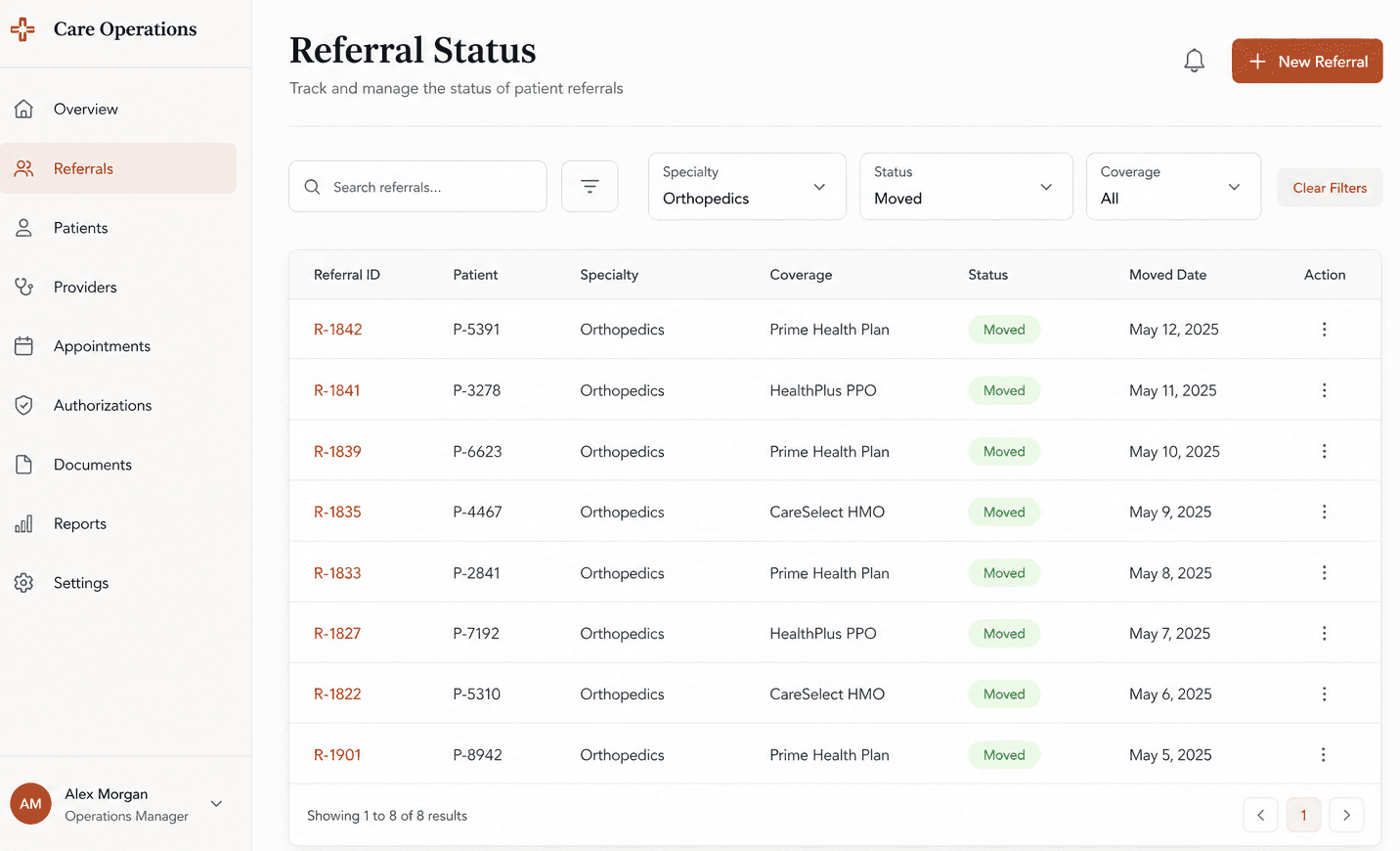
Flagship case. An illustrative composite of HMS healthcare work: the operator screen that asked whether a referral had moved — Java, Spring Boot, SQL, React, AWS.
35% faster APIs · 40% shorter deploys
care.internal/referrals
- Problem
- Healthcare workflows stalled on slow APIs and heavy SQL. A change took too long to reach production, so the team batched work and waited.
- Constraints
- Existing Spring Boot microservices, production traffic, and integrations that could not be paused for a rewrite.
- Decision
- Keep the service boundaries. Spend the work on API design, SQL, and a Jenkins + Docker pipeline so a release was a habit instead of an event.
- Tradeoff
- Calendar time went into design conversations that delayed some features. Those two résumé numbers are the ones I would still defend in a room.
- How it was measured
- 35% faster API response times and 40% shorter deployment time — the résumé numbers. The referral-status framing is an illustrative composite of that HMS work, not a production runbook.
- React operators
- Spring Boot APIs
- SQL — bottleneck: status reads
Same service boundaries. The wait was in the query, not a new service.
Healthcare software has a particular silence to it. Nobody thanks you when a referral moves. They only appear when the status screen takes too long for someone who is already tired.
At HMS that screen was referral-status: React for the operator, Spring Boot in the middle, SQL and AWS underneath. The expensive moment was not the late change. It was the early silence — when everyone felt the slower query and nobody said it.
I said it, then proved it in the plan and the pipeline. The service kept its name. The wait on the screen did not.
- Java
- Spring Boot
- SQL
- REST APIs
- React.js
- AWS
- Docker
- Jenkins